by Claire Doole | Dec 23, 2016 | Blog, Moderating
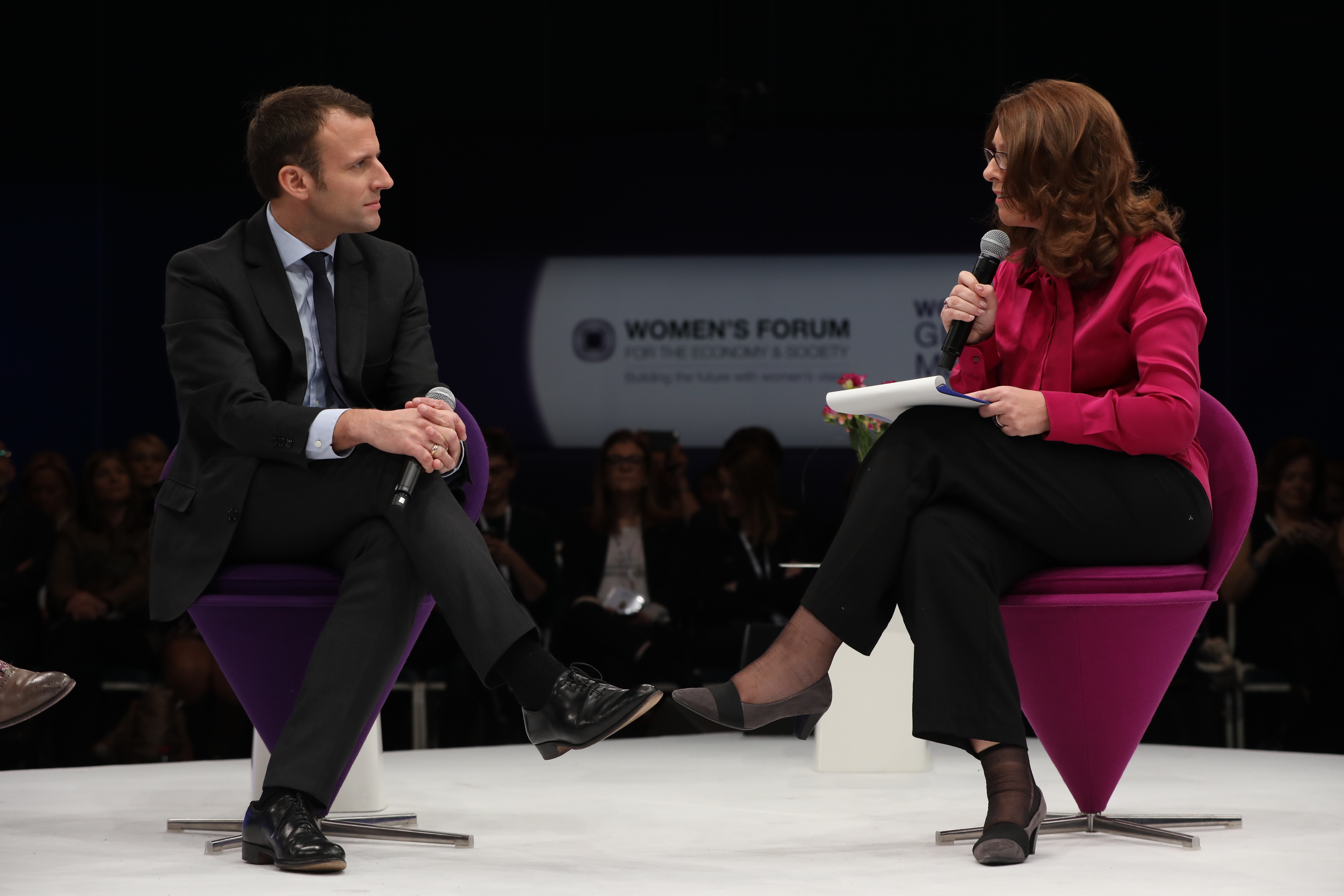
Emmanuel Macron, the French presidential hopeful, was getting ready to take the stage, and all I knew as panel moderator was that he was meant to sit in the chair second to the left.
He and I were taking part in the Women’s Forum for Economy and Society in Deauville. I had no idea what he would say on our panel discussion about the economic advancement of women. His PR team were nowhere to be found.
So when the makeup artist whispered to her colleague that she was about to go upstairs to do his make-up, I followed her into the inner sanctum.
I needed to know if he was willing to speak in English – a red line for some French politicians – or whether he would be speaking through an interpreter. I wanted to briefly introduce myself and the first topic for discussion – the gender pay gap between men and women. From experience, I know it is important to build rapport with high-level panelists, and to sense if they get my British humour.
He did – peering over my clipboard and asking what questions I would be posing – in perfect English.
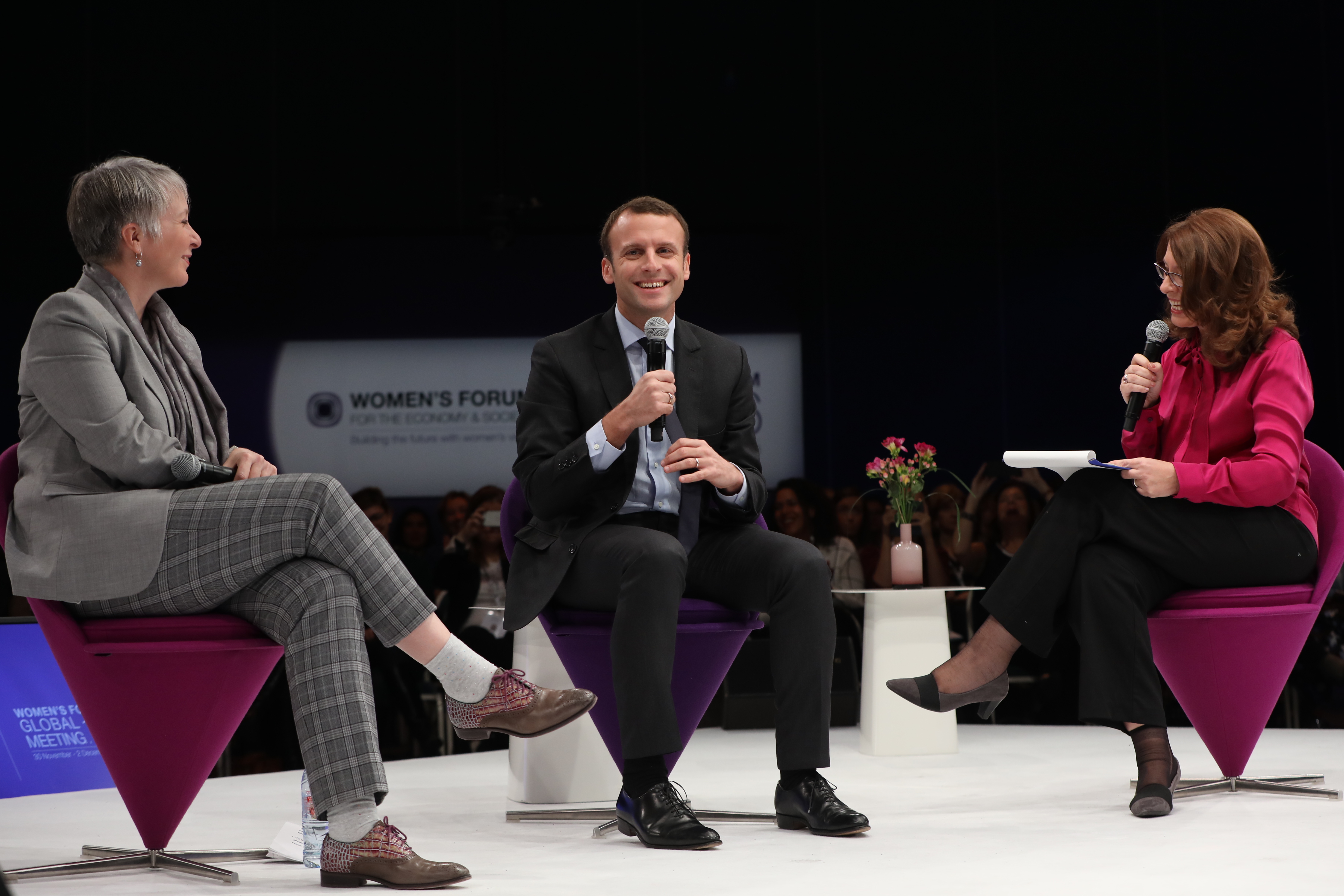
Patty Hajdu, Canada’s Minister for Women, Emmanuel Macron, French Presidential Candidate, Claire Doole, Moderator.
He was a master communicator. He understood the audience and did not dominate. He accepted graciously the business card I gave him from the founder of a feminist group I had met the previous night. She had calculated that at the current rate of progress women in France would be paid the same as men in 2186!
He even understood my humour as I asked him if he was or had ever been a feminist.
It was a sound bite that worked for him too as it went viral on Twitter.
All of this with no preparation from his PR team. The communications teams for the other panelists – Patty Hajdu, Canada’s Minister for the Status of Women, and Arancha Gonzalez, Executive Director of the International Trade Centre – had been very helpful with background information.
If you are going to successfully moderate high level panels, you do need to prepare. You have to do your homework as an advanced briefing from PR teams does not always happen. However, if you do meet with panelists’ PR teams be wary, they might try to stifle debate! The day before meeting Macron, I moderated a panel with the CEO of Coca Cola, Muhtar Kent, on why he was a feminist.
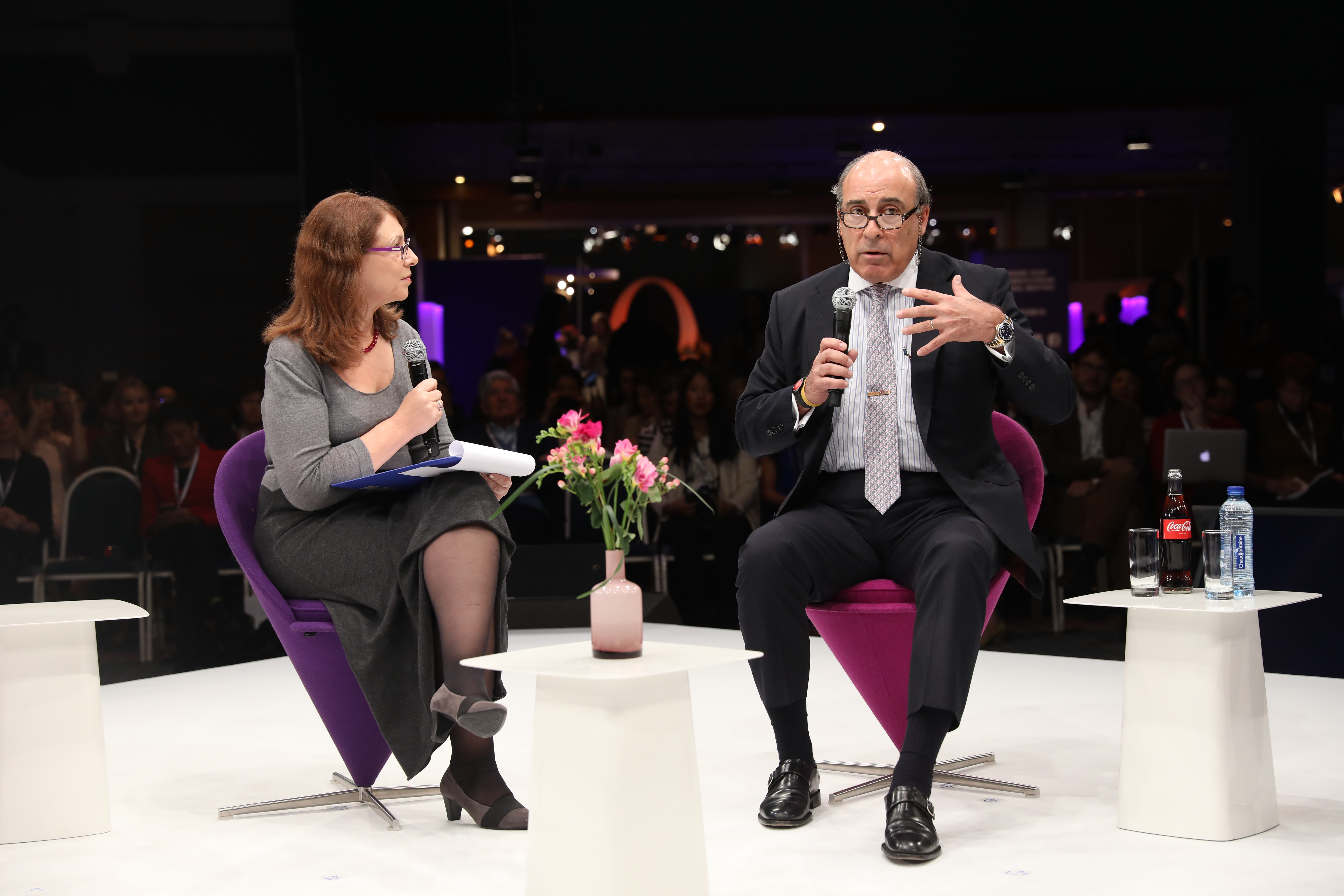
Interviewing the CEO Coca Cola Muhtar Kent about why he says he is a feminist.
Mr Kent’s PR team were much more controlling – keen to know my questions and those of the other two women who were on the panel. I gave them broad areas.
With hindsight, I can understand why they asked. He resigned as CEO 7 days later after what the Wall Street Journal called “a rocky eight-year run at the top”.
During that time, he had doubled the number of women on the Board of Directors from two to four, but parried my question on when there would be gender parity on the 14-member board with the word – “soon”.
He saw the event as a win-win to explain how Coca-Cola was empowering women in the countries where it operates. He even managed some product placement much to my chagrin, a photo reproduced in Forbes and Grazia magazines.
Hot on the heels of these panels in Deauville, I was asked, at one of the moderating workshops I run, for my 5 top tips on handling high -level panels.
Here they are:
• Be prepared, but ready to go with the flow
• Build rapport even if you only have a couple of minutes beforehand
• Listen intently and ask follow-up questions
• Ask the questions the audience wants asked
• Don’t be swayed by the PR team!
Interested in watching the whole debate? Here is the panel with Emmanuel Macron, Patty Hajdu and Arancha Gonzalez on the economic advancement of women.
And if you would like to find out why the CEO of Coca-Cola, Muhtar Kent says he is a feminist, click on this link.

by Claire Doole | Oct 31, 2016 | Blog
Many of the people I coach in the art of powerful presenting are highly intelligent and articulate. They are medical doctors, academics, bankers and lawyers.
But they are not journalists, like myself. They often don’t have an innate sense of storytelling or they know too much and struggle with getting the level of detail right.
This is where structuring your thoughts for maximum impact comes into play. I recommend two ways to structure your thoughts that will guarantee the audience is focused on the key messages, and not on trying to decipher meaning in a disorganized presentation.
IMPACT
All trainers love mnemonics – memory devices. Here is one to help you structure a presentation.
Introduction – get the audience’s attention with a bang and make sure the benefits are clear.
Main messages – outline your purpose and your key messages – what do you want the audience to take home so that you achieve your purpose? Do you want to inspire, sell, persuade or inform?
Points – what are your main points? How are you going to structure them? Chronologically, most important to least important, geographically or thematically? Remember to support your points with facts, data and stories.
Associate – make sure your supporting examples are relevant to your audience.
Conclude and recap – summarize and repeat your key messages.
Take-away – finish with a bang. This can be a call to action – what do you want your audience to do, feel or say as a result of your presentation?
It follows the old adage – tell them what you are going to tell them, tell them, and then tell them what you have just said. Believe me repetition in spoken communication helps make your messages stick.
MINTO PYRAMID
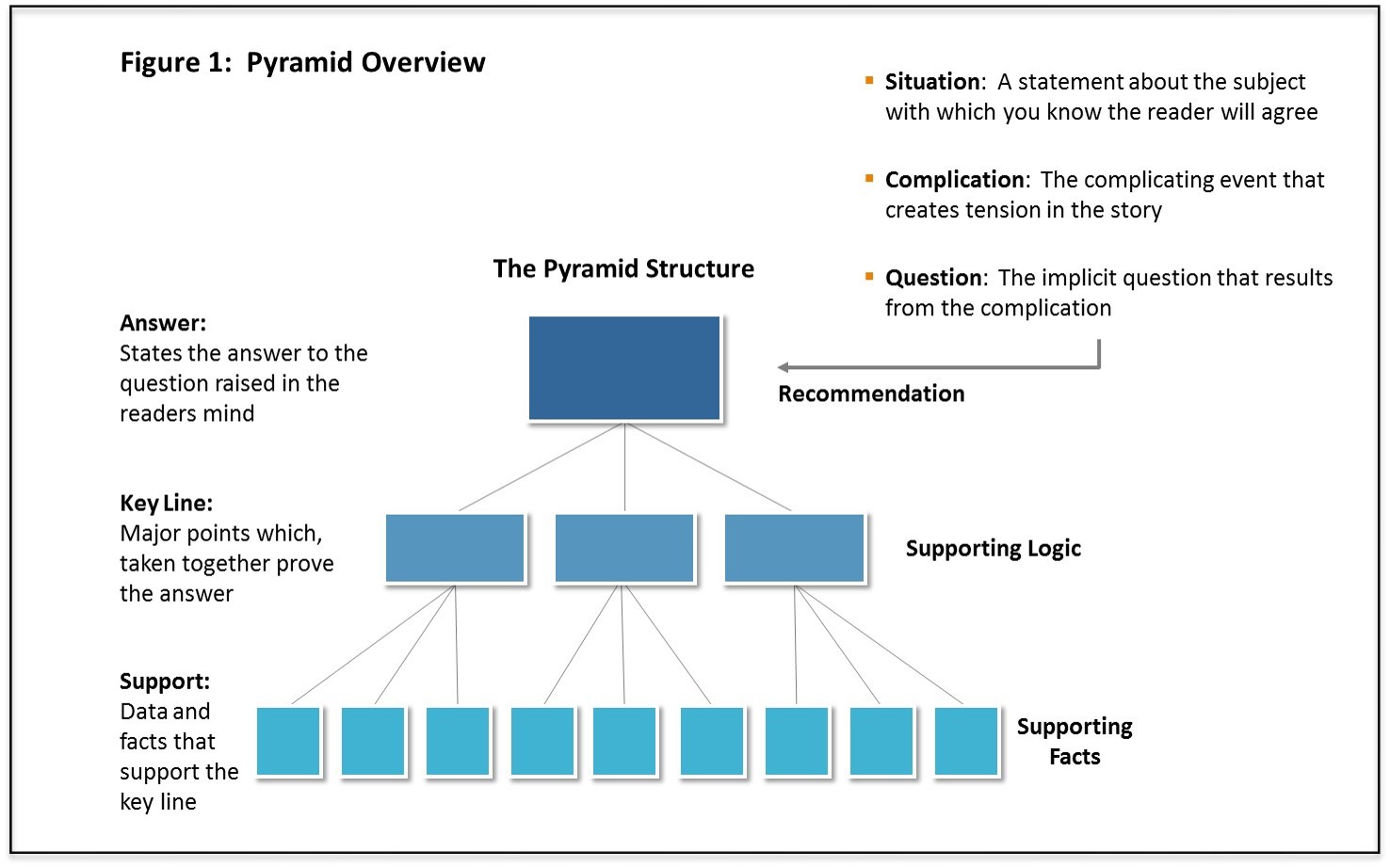
All communication involves an element of persuasion. Barbara Minto developed the pyramid principle in the 1960’s. It is effective if you want to persuade somebody with an argument. It works well when writing, presenting proposals or recommendations, making an elevator pitch or responding to a busy executive’s question.
You start with an introduction that takes your audience through the following steps:
Situation – describe the situation so it is easy to understand. This can be something that the audience already knows or you know that they will agree with.
Complication – introduce the issue or issues that make the situation problematic.
Question – ask the question that leads to the answer you want to give in your proposal or recommendation. It can also be the answer to the question the executive wants answered such as “what should we do?”
Answer – this resolves the complication you identified.
The body of the presentation deals with the solutions you are proposing. As you know, people rarely remember more than three points so divide your solutions into three, and for each ensure you have supporting information to make your case.
At the end you can recap the solutions, your key messages and either end with a call to action or outline next steps.
As this is not a mnemonic, it will be easier to understand visually.
Call to Action
As I said earlier, it is vital that you and your audience know what you want them to do as a result of listening to your presentation.
So, as a coach/trainer, who walks the talk, if you would like to
find out how to structure your thoughts clearly and compellingly, please do get in touch.
In my next monthly blog, I shall be sharing tips on how to use stories to get your message across.
by Claire Doole | Sep 28, 2016 | Blog
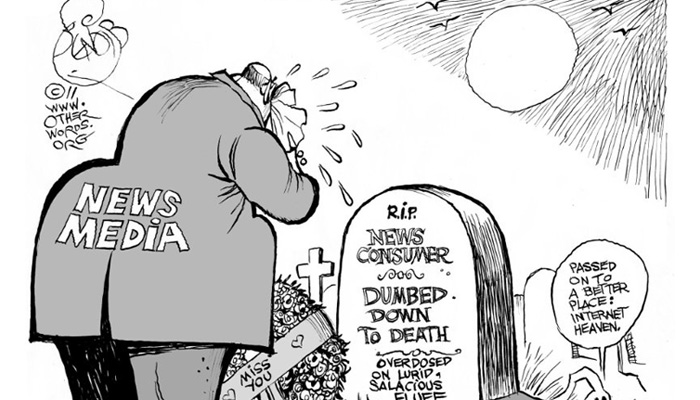
 The media, particularly but not exclusively in western countries, is in crisis. Ever since I left the BBC, the corporation affectionately known as “auntie” has been laying off thousands of its nephews and nieces!
Newspaper conglomerations are firing journalists in droves in the UK, US, Brazil and even in Switzerland, where I am based.
The “fortunate” journalists who are left behind have to do more with less.
And in this digital world they have to work on all fronts.
For more bittersweet insights into the depressing state of journalism see last month’s episode of “Last Week Tonight” with John Oliver.
What does this mean for you?
The traditional print and broadcast may not have the time or resources to write your story, attend your press conference or go on your press trip, but many are more open to accepting your written or visual content.
The BBC used to be reluctant to take video footage, known as B-roll or vides news releases, from organisations. But today the BBC and other major broadcasters such as Al Jazeera, Euronews, CCTV, Russia Today regularly download broadcast quality content from the ICRC video newsroom.
Unable for financial, logistical or political reasons to send their reporters to conflict zones, they build their stories using this free content. Some though like the BBC baulk at using the interviews of the agency spokespeople or representatives.
If you have newsworthy content, you can even decide which media to offer it to. The ICRC recently found itself in the enviable position where The Sunday Times and the BBC were interested in publishing the account of the siege war and suffering in Madaya by the head of the ICRC delegation in Syria. The article was published on the BBC website, where it was one of the most read that week.
When journalists become PR people
If you can’t rely on that resource in-house, you can follow the example of the UN refugee agency, which has a roster of freelance journalists who report on asylum and refugee issues.
Do you remember the story of this girl?
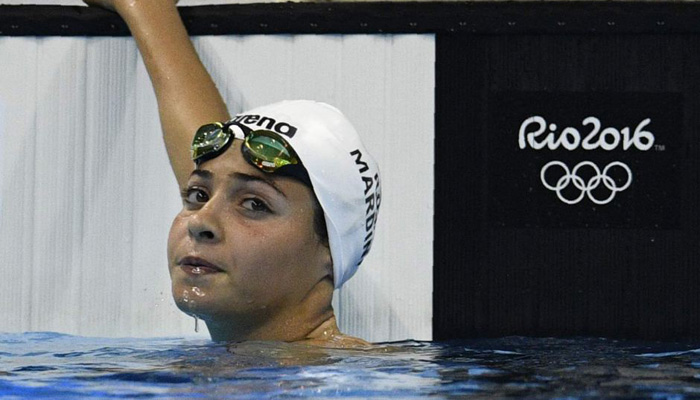
Yusra Mardini is the Syrian girl who swam at the Olympics in Rio as part of the refugee team. Well, a journalist in Berlin contracted by the UN refugee agency first broke this story, which was picked up by the world’s media.
I personally wonder if a journalist paid to write an article by an organisation can objectively report on that organisation when it is in the news.
But I am told this is an issue for the media outlet and or journalist and not the organisation. It would seem though important that it is made clear that the journalist can report on the organisation’s issues and that they should not feel obliged to self censor for fear of offending their PR client!
It is a model that is gaining traction. I know of a number of print and broadcast journalists in Geneva who write or produce video for international humanitarian organisations. Unable to make a living from pure journalism, they welcome the extra income.
Keeping the editorial line
There are still some die-hard publications, which you will find it difficult to convince to take your copy, even if it is extremely well written. The New York Times recently turned down a powerful story about healthcare workers in South Sudan written by a former journalist now working as a public relations officer at the ICRC.
But the New York Times seems more open to taking text if it comes with photos, especially if they are “laundered” through the photographic agency you are working with. Recently the newspaper accepted this story commissioned by UNICEF on Syrian refugees coming into Europe
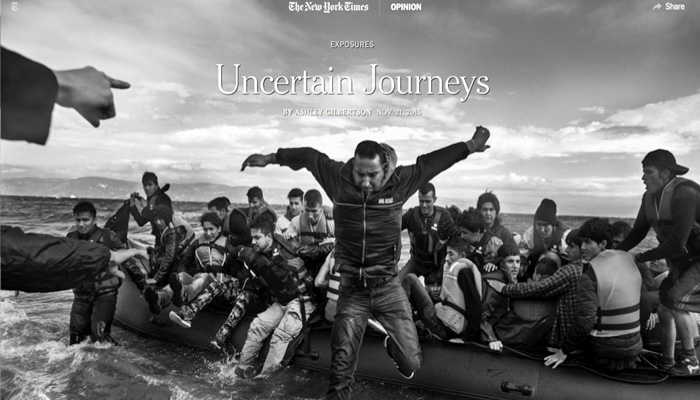
It was, however, placed in the opinion section. The first time the New York Times had a visual editorial.
The boundaries between journalism and public relations are moving. The two professions have always had a symbiotic relationship but with the media in crisis, for the moment, it would seem that more journalists are moving into PR full-time or on a freelance basis.
If you have a budget to employ or to contract them, you can be certain that it will be easier to get the story of your organisations issues or activities covered in the way you want it to be told.
Images by
other words.org,
abc.net.au,
NYTimes
by Claire Doole | Aug 29, 2016 | Blog
I hear all too often people saying, at events and conferences, that they enjoyed the networking but that the panel discussion was disappointing.
Why does this happen? The panelists are not experts so lack credibility, pressure to put sponsors or friends in the limelight, poor moderating?
Or is it just that panelists don’t know the rules of the game?
As a professional moderator, drawing on my background as a BBC journalist and presenter, I wanted to share with you some of my observations and tips on how to become the perfect panelist.
# Be prepared – Think about why you were invited. What messages matter to the audience? What do you have to say that is interesting and new? What evidence do you have to back up your comments? What do you want the audience to takeaway?
# Arrive early – Make sure you attend the speakers briefing. Check the microphones, the seating and room acoustics. Give yourself a few minutes to relax and focus before you go on stage.
# Be clear, concise and conversational – Don’t talk in jargon, the audience won’t understand. Do not go off topic or sound scripted.
# Be memorable – Bring something personal to the discussion, an anecdote, a story or even a prop to underline a point.
# Add to the discussion flow – Don’t just repeat what the previous panelist has said. Remember to use the “yes and” as well as “yes but” techniques to keep the conversation going.
# Be engaged throughout – Listen with intent. Even when you are not talking, eyes are still on you so avoid the “emotional leakage” that tells the audience you are tired, bored or distracted.
# Be timely – Stick to the time agreed with the moderator for your opening remarks and closing comments. When the moderator or conference host indicates it is time to wrap up don’t tell them either they are too “Anglo-Saxon” or “like a Swiss cuckoo clock”. Honestly, I have not made these quotes up!
# Be courteous – Remain polite towards the other panelists. Don’t cut them off, talk down, dominate, always have the last word. Avoid having a one-on-one conversation with one of the panelists, excluding the others and the audience. I have seen this happen, and you can guess the gender of the culprit…
# Be respectful – It takes courage to ask a question in public during the Q and A session. Acknowledge the contribution. If the question is not clear, do reframe it for clarity.
# Do not rush out of the event – Stay and mingle with participants – you have just been a great panelist and can expect lots of interest in your work and ideas.
Remember it is not just about being an expert, but also being likeable and building rapport with the audience.
Related articles:
Creating a perfect panel
Taking the stress out of moderating
If you would like to attend a workshop or have a coaching session with Claire on how to moderate like a professional or have Claire moderate your event, do get in touch.
by Claire Doole | Jul 12, 2016 | Blog
Moderating a panel discussion is stressful. The moderator has to master the subject matter, keep the panelists on message, and manage the audience’s attention span.
It is very easy to do badly – much harder to do well.
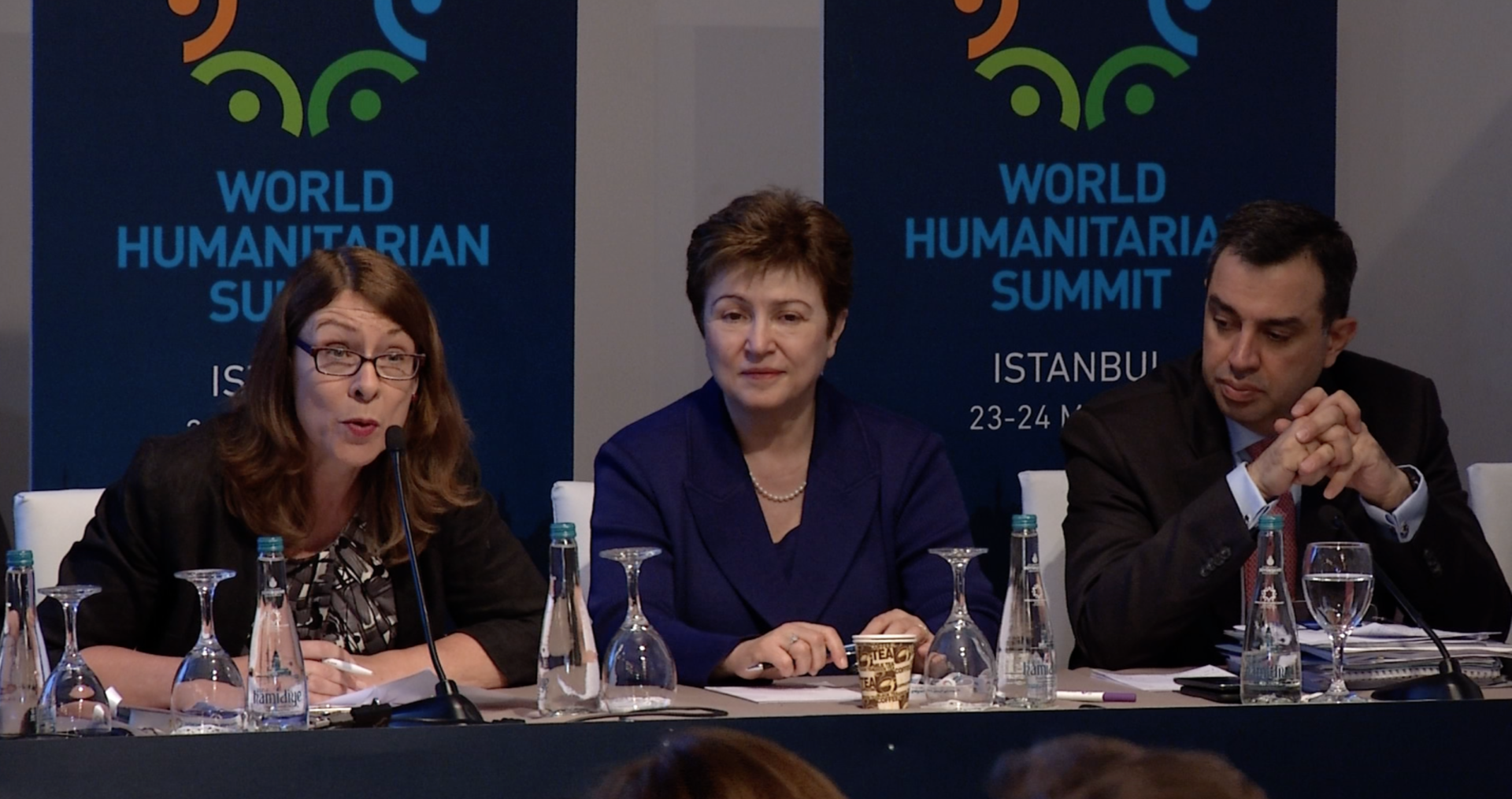
Recently, I moderated two high-level panels at the World Humanitarian Summit in Istanbul, where the International Committee of the Red Cross (ICRC) was launching a new financing mechanism with the support of the Belgium government.
When you have panelists of the caliber of the deputy Prime Minister of Belgium, President of the ICRC and Vice President of the European Commission, how do you as the moderator ensure that the discussion flows and the audience is captivated?
Below are my 10 tips for those who have been asked to moderate an event, or to brief a professional moderator:
• Allow time for briefings
I ask the organiser to explain the purpose of the event and the key messages to come out of the discussion.
• Do your research
I google the speakers, watch them on YouTube and see if they have done a TED talk, as this gives me a good idea of what they have to say and how they come across.
• Skype beforehand
I organise a Skype call with each panelist, so I can find out what they want to say and comment on. I send them the line of questioning with a proviso to be ready for follow-ups and to react to the other panelists. I also send detailed timings.
• Meet the speakers on the day
This builds rapport, ensures you know how to correctly present them, and gives you a chance to go over who sits where and which mikes to use.
• Position yourself within eyeshot
I sit either in the middle or on the end, but I make sure I have eye contact so I can either encourage participation or intervene if need be.
• Nail your opening
The first 40 seconds is key as you are at your most nervous and the audience is weighing you up. I set the tone with some punchy opening remarks – similar to a TV or radio presenter. (See the video at the bottom of the page)
• Keep the panelists to time
I am not afraid of intervening if someone is failing to answer the question or taking too long to make a point. I know that this usually gets the thumbs up from the other panelists and the audience.
• Observe the audience
If they are disengaged, I encourage them to participate – asking for a show of hands, and going to questions early.
• Questions rather than comments
When I introduce the Q and A session, I remind the audience that I am looking for questions not remarks. I repeat the question so everyone understands it
• Bring the event in on time
I summarise the main points at the end, ask the panelists to give their final remarks or call to action in no more than a minute. I back-time the event like a radio or TV programme ensuring we come out on time.
Follow these tips and your panel discussion should flow like good wine!
If you are still wondering about how to make a punchy opening, watch how I did it at the World Humanitarian Summit in Istanbul. My opening remarks are at 00:12.
Moderating high-level panels at the World Humanitarian Summit from Claire Doole Communications on Vimeo.
PS: Are you not moderating the panel, but still organising it?
Then read my blog How to create a perfect panel and do select a moderator who takes the stress out of moderation for everyone concerned.
by Claire Doole | Jul 11, 2016 | Blog
I have just come back from Mauritius where I was interviewing some amazing women at the Women’s Forum for the Economy and Society.
I also had the opportunity to observe many top class panels on the themes of sustainable development and climate change. This got me thinking about what makes a perfect panel.
As a former BBC correspondent and presenter, I am often asked to moderate panels and know how stressful they can be for everyone concerned.
So on the 11-hour flight back to Geneva, I jotted down some notes on how to take the stress out of moderation.
They are based on my experience as a moderator, but also as a BBC producer and presenter. For many years I set up panel discussions for myself or other journalists to present. I had to come up with a newsworthy topic and then find, two, maximum three, panelists. I was looking for subject experts, who had different opinions and who could express them clearly, concisely and compellingly.
Below are my 10 tips for organisers on creating a perfect panel:
#1 Select on merit
No one should have a seat on a panel just because they are a friend of the organiser or a sponsor of the conference to sit on a panel. Everyone should be there based on the relevance and power of their ideas.
#2 Test them out
You need to draw up a short-list of candidates and start speaking to them. Do they have something to say that the audience has not heard before? Are they willing to be challenged or express views on related subjects? Are they articulate?
#3 Restrict the panel size
A friend once had to moderate a panel of 10 people. Needless to say it was a disaster. Three or four panelists are ideal as this gives enough time for them to present their ideas, engage with each other and the audience.
#4 Add gender diversity
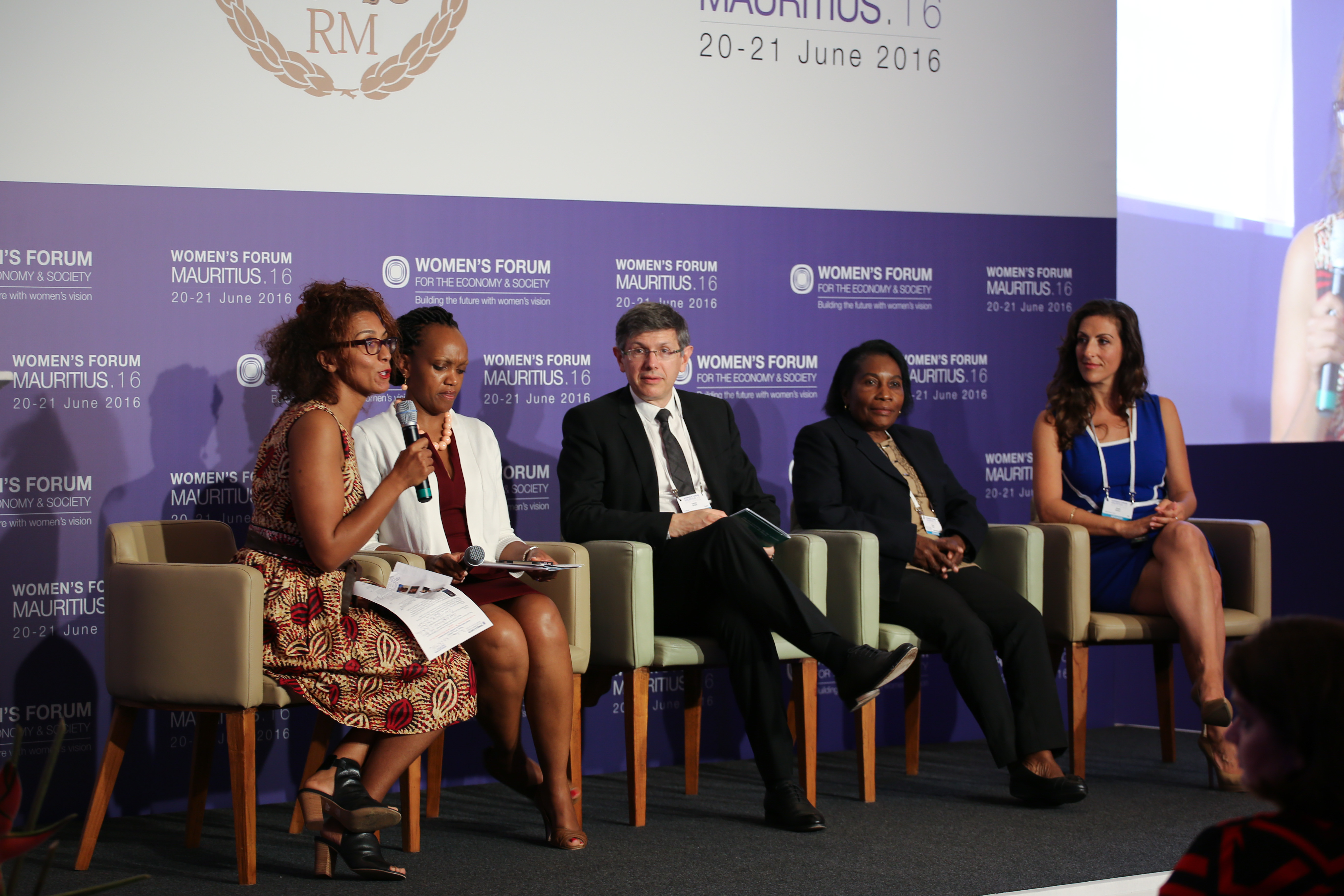
A mix of men and women is ideal as it is so much more interesting for the audience to hear and see different views on a panel. As you see from the photo at the top of this blog, the Women’s Forum gets top marks for panel size and diversity.
#5 Avoid death by PowerPoint
PowerPoint is a crutch. Most people use it wrongly – the documentation as presentation syndrome. If the format of the panel is for each person to do a short presentation then a couple of highly visual slides work. But once you are into the discussion, PowerPoint breaks up the flow.
#6 Say no to Skype
At the Women’s Forum I did do an interview over Skype (audio only due to bandwidth issues), but this was because the participant was not able to attend due to ill health and one of the most naturally powerful communicators I have ever encountered.
But Skype does not work for panels. I had the misfortune once to moderate a discussion where the first panelist came over Skype. The sound and picture quality was appalling. On top of this her English was too heavily accented for anyone to understand what she was saying.
#7 Fluency
In the previous instance, I also had a panelist who said he understood English but in fact he didn’t so he could not interact with the woman on Skype. Check the language the panelists want to speak in and arrange professional translation if needed.
#8 Vary the length of the panels
At the Women’s Forum the panels varied from 35 minutes to 1 hour 25 minutes. The length depended on the subject matter and number of speakers. Varying the length also helps the audience better focus, as everyone tends to overestimate attention spans.
#9 Select a competent moderator
Good moderation can make all the difference to the success of your conference. If you have a budget, pay a professional moderator as they can ensure your event is engaging and memorable for the audience.
moderation services
#10 Involve the moderator
Brief the moderator on the purpose of the panel. Ask them for their ideas on creating a perfect panel.
Have a look at this video from the Women’s Forum to catch some superb moderators in action.
Women’s Forum for Economy and Society from Claire Doole Communications on Vimeo.
If you are going to moderate yourself or brief a professional moderator, do read my blog on the taking the stress out of moderation.