by Claire Doole | Sep 4, 2022 | Job interviews
Earlier this year I was asked to sit on an interview panel for a Director of Communications position. The organisation requested my support to reduce eight candidates down to four through a series of written and communication tests. I have helped a number of people prepare for job interviews with international organisations and companies, but I had not been in the recruiter’s chair for many years.
It was a great vantage point to assess what works and what doesn’t.
Below are ten observations based on interviewing candidates remotely:
1. Prepare. It is a cliché, but preparation does prevent poor performance. I was shocked that some candidates had scant knowledge of the organisation’s vision and mission and had not thought enough about the value they could bring. Employers are looking for what you can do for them: what gaps you can fill and what problems you can solve.
2. Don’t over-prepare. One candidate had obviously been privy to some confidential information and revealed it. This did not go down well with the panel.
3. Be prepared to answer questions based on your tests and motivation letter. As a side note, make sure that your cover letter is a single page. It should be employer centric and make them want to read your CV. (We received one letter that was 7-pages long – not a good indication of someone’s ability to be clear and concise!)
4. Give examples of what you like about the organisation’s mission, values and activities, and where it can improve.
5. Keep your answers short – less than 1 minute as it is very easy for the interviewer’s mind to drift. If they want to know more, they will ask follow-up questions.
6. Have real examples of when you have failed or not succeeded. This makes you more authentic.
7. Give examples of your experience from across your career and not just from one job, as this shows the breadth of your knowledge and expertise.
8. Don’t b…s…t! Interviewers are usually very senior and a good judge of character. They have interviewed countless people and can spot someone pretending to be someone they are not!
9. Don’t read your answers from a script. Everyone can see your eyes moving from left to right. It says you are not a great communicator as the audience loses connection and interest.
10. Look straight into the camera. If you look away and your eyes dart everywhere, it can make you seem unfocused and rather maniac!
Have a look at my other job interview blogs on how to succeed at video job interviews and how every interview is a presentation.
by Claire Doole | May 30, 2019 | Blog, Storytelling
In presentation training, we focus on storytelling as a way of building emotional connection with the audience. Stories win hearts and minds, inspire and motivate and engage and entertain.
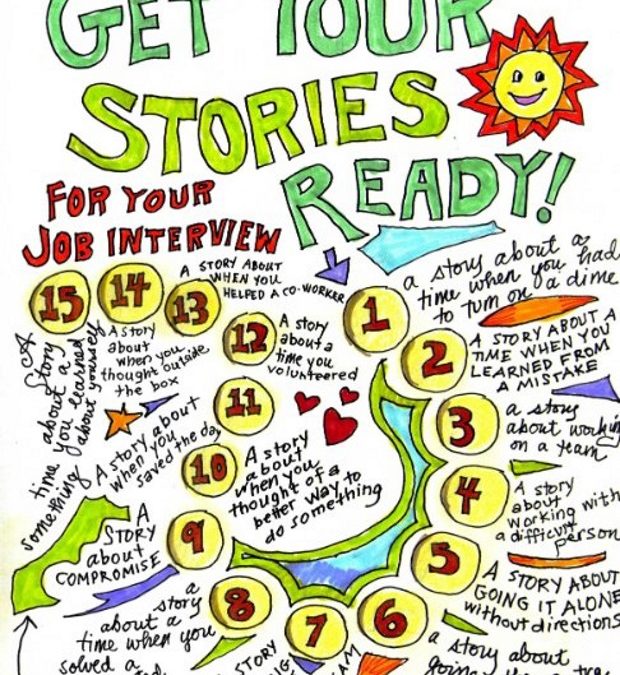
In a job interview, stories can be extremely effective. They will help you stand out in the interviewer’s mind and highlight your key competencies.
Often, you will make a series of assertions such as I can help you increase sales, attract more funding or influence legislation. However, you will need to provide evidence for the interviewer to take you seriously. This is where stories, which are based on real-life examples, can help you come across as genuine and credible.
In my job interview coaching, we examine some typical questions, like the ones below, and apply storytelling techniques.
• Tell us about yourself.
• Why do you want to work for us?
• Why do you think you are the right person for this job?
• Tell us about a time you have succeeded/ failed.
• How do you deal with conflicts at work?
• Tell us what you don’t like about your current working day?
• What sort of things do you and your boss disagree about?
• What is your greatest strength and how will it help you in this job?
• What do you see as the most challenging part of this position?
As you can see, the interviewer is looking to assess your motivation, determination and spirit of collaboration. These are abstract concepts, and unfortunately the human brain is particularly bad at remembering the abstract. So you need to back them up with concrete examples or stories.
The 5 elements of a powerful story
In order to make an impact, your story needs the following elements:
1. Clear structure. You need to set out the context – explain who was involved, when, and where. There has to be some action – something has to change and then comes the resolution. In a presentation, the story serves to reinforce a key message. In a job interview, it can spotlight the actions you took to resolve a problem or challenge and the results that followed. If you can add a key learning such as – this taught me that you have to persevere and not give up – this will reinforce the impression that you are someone who reflects and learns from the past.
2. Human interest. If you are telling a story about a project or programme explain how you felt during the process. How did you feel when faced with a challenge? How did you feel when the situation was resolved either positively or negatively? And how did the people involved in the project feel – were they overjoyed, inspired or relieved?
3. Credibility. Your story must be true and based on fact. It will also be much easier to relate and remember if it is your story.
4. Topicality. If you are using a case study as one of your examples, it should still be valid and not have been overtaken by events.
5. Relevance. It helps if your story is relevant to the audience either geographically or close to the sector they are working in. For example, if you are applying for a job with a food company, but come from an environmental background, you might want to talk about an initiative you led on sustainability as this could be relevant to their policies on food waste, recycling or naturally sourced food.
And one last thought, be ready to answer some of those personality questions with stories from your non-work life. Some interviewers, for examples, like to questions such as – tell us about your childhood /what do you do outside work/tell us what makes you smile. All of these are great questions for a short personal story.
In my next blog I shall look at how to deliver that powerful story during an interview.